Using Team Diagnostics to Power Team Coaching

5-minute read
Written by Shawn Bakker, Lead Psychologist
Every team coach or HR professional has encountered this moment: you're sitting with a group of talented people who, on paper, should work beautifully together. Yet meetings drag, conflict quietly festers, and no one is quite sure why. Some team members dominate discussions while others disengage. Big ideas get floated but never implemented. Change initiatives stall. Sound familiar?
The challenge isn't usually skill or motivation — it's awareness. Teams struggle when individuals don't understand themselves, and each other. This is precisely where team diagnostics change the game.
Teams Are People First
It's tempting to think of team effectiveness as a process problem. Build better meeting rhythms. Clarify roles. Improve project management. These things matter, but they're built on a foundation that's fundamentally human. Teams are collections of individuals who each bring distinct strengths, communication styles, problem-solving approaches, and reactions to conflict. How those individual styles combine — or collide — shapes everything about how a team functions.
Understanding a team, therefore, requires understanding its people: how they differ, where they overlap, and what those dynamics mean for the work they share. This is what team diagnostics reveal.
A Picture Worth a Thousand Words
Assessment data gives teams something they rarely have: an objective, shared picture of who they are. When a team can see, visually, how its members are distributed across different work styles — who leans toward relationship-preservation in conflict, who pushes hard for their position, who avoids the friction altogether — something shifts. Abstract interpersonal tensions become concrete and discussable. Differences that once felt personal start to look structural.
Team Dynamics – Problem Solving
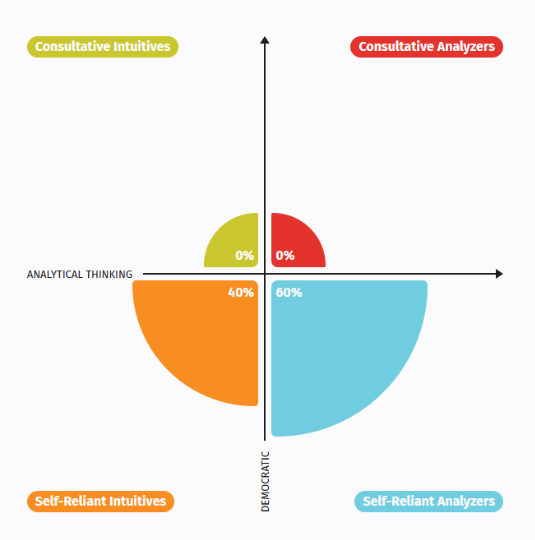
Consider the senior executive team above – a group of individuals with high-levels of self-reliance and little consultation when solving problems. This visual promotes a shared awareness that is hard to achieve through conversation alone. And when every person in the room is looking at the same data, it creates a common language — one that makes it far easier to say "We probably don’t involve others enough” instead of letting assumptions harden into resentment.
Where Diagnostics and Coaching Converge
Without data, coaching conversations can feel vague or personally threatening — people aren't sure whether feedback reflects objective patterns or someone's opinion of them. With assessment data, the team starts from a shared baseline. Conversations become grounded. Blind spots get named. The team can look at its profile and ask: given who we are, what should we start doing, stop doing, and keep doing?
This is particularly powerful for recurring team challenges. When a team consistently struggles to make decisions, or when innovation stalls in the implementation phase, or when certain voices are consistently heard over others — diagnostics help identify whether these patterns are rooted in style distributions across the team, rather than individual failures or bad intentions.
Making It Stick
The teams that benefit most from this approach treat it as a continuous practice, not a one-time intervention. Just as effective organizations build in regular one-on-ones and weekly check-ins, they also create deliberate space for the team to reflect on how it's working — not just what it's delivering. As individual team members develop greater self-awareness and openness to each other's styles, the quality of collaboration, problem-solving, and even conflict resolution improves noticeably. And that ripple effect doesn't stay contained to one team.
For HR professionals and consultants supporting leadership and team development, the combination of robust team diagnostics and sustained coaching represents one of the highest-leverage interventions available. The data gives teams clarity. The coaching gives them somewhere to go with it.
Using Psychometrics Team Dynamics
Team Dynamics is a dashboard that brings individual Work Personality Index® (WPI) results together into a shared, team-level view. It helps managers and team leaders understand how different work styles interact across the group, revealing patterns that influence communication, collaboration, decision-making, and change. The dashboard is included with all of our WPI reports.
By visualizing collective strengths, gaps, and differences, Team Dynamics supports clearer conversations about how the team works together and provides a shared, work-focused language leaders can use to guide alignment and integration.