Thomas-Kilmann Conflict Mode Instrument (TKI®)
Resolve and Prevent Workplace Conflict
Help People Tailor Their Approach To Conflict Situations To Resolve Differences With Others.
Workplace friction often stems from the habitual approaches people bring to problem solving and decision making. Whether you are building a new team, preparing leaders for high-stakes collaboration, or breaking through entrenched friction, the Thomas-Kilmann Conflict Mode Instrument® (TKI) turns conflict into opportunity.
The TKI is the most widely used and research-backed conflict tools worldwide, and is available in English and French.
Why Teams Experience Conflict
Workplace conflict is both a significant cost and an opportunity for growth. The TKI provides a neutral framework for discussing conflict behaviours without making it feel personal or unproductive.
People react out of habit…
Most people default to their known conflict modes in every situation. They compete when they should collaborate, avoid when they should assert, or accommodate when they should push back.
…show them their pattern and offer a new approach.
The TKI reveals which modes a person overuses and underuses. Once people see the pattern, they can start making deliberate choices instead of falling back on habit.
Conversations about conflict feel personal…
Without a framework, feedback about conflict behaviour feels subjective or like a personal attack. People get defensive, shut down, or escalate, and nothing changes.
…give teams a neutral language and framework.
The five conflict modes provide a shared vocabulary that separates the behaviour from the person. Teams can discuss patterns openly, without blame.
Leaders struggle to coach their team members through conflict…
Without a framework, managers either avoid difficult conversations or handle them inconsistently. They lack the tools to help their team members navigate disagreements productively.
…leaders gain a framework and shared language.
The TKI gives managers a clear, practical model for understanding their own conflict style and coaching others through theirs. No labeling styles as “good” or “bad,” just building awareness of when each mode works best.
Teams assume “collaborating” is always the right approach…
The instinct to collaborate on everything sounds productive, but it leads to meeting fatigue, slow decisions, and frustration when people feel like their time isn’t being respected.
…teach situational flexibility.
Each mode is effective in specific situations. Competing works for urgent decisions. Avoiding is appropriate when an issue is trivial. The goal is knowing when to use which approach.
Measure Five Conflict-Handling Modes Within Your Team
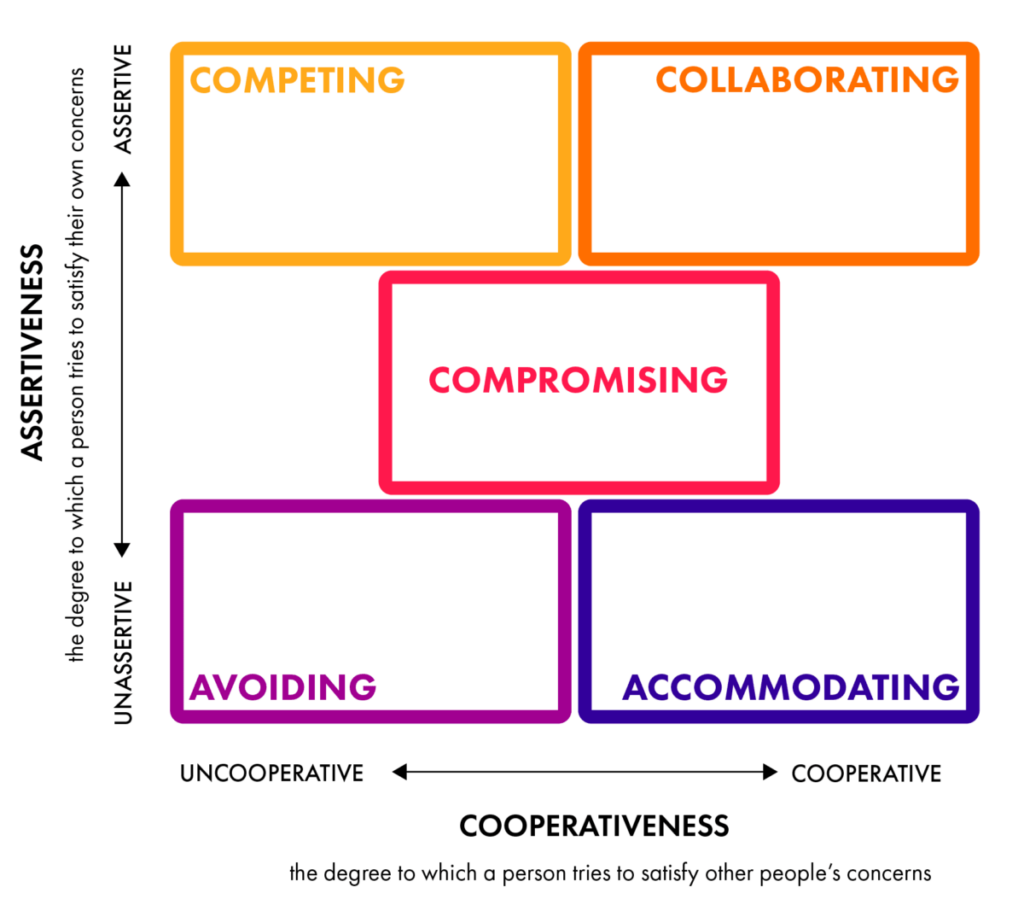
The TKI framework maps five distinct modes across two dimensions: assertiveness (the extent to which you try to satisfy your own concerns) and cooperativeness (the extent to which you try to satisfy the other person’s concerns).

Looking to Resolve Conflict and Build Resilient Teams? Talk to a TKI expert!
Prefer to call? You can reach us at 1.800.661.5158.
TKI Benefits and Applications
The TKI can be used as a stand-alone tool, in group workshops, or integrated into broader development programs. It works at every organizational level, from front-line staff to senior management.
What’s Inside the TKI Report
Get one comprehensive and easy to interpret report. HR professionals and consultants can quickly identify conflict behaviors and individual developmental needs.

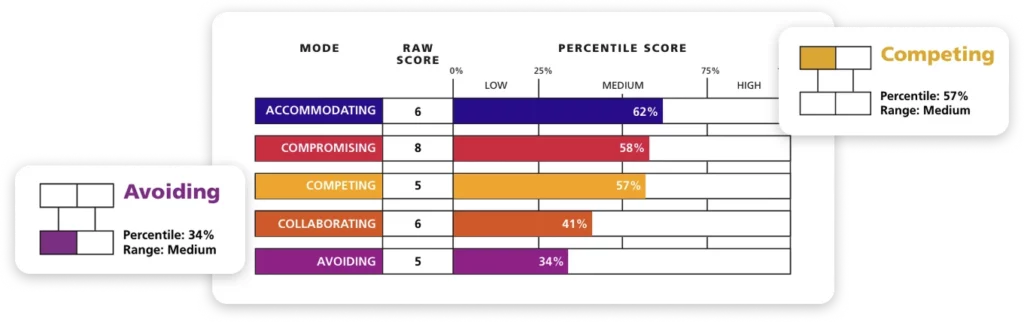
Conflict Mode Scores
The report provides a visual profile of behavior across five conflict-handling modes. Individual results are presented as percentile scores to show how a person’s responses compare to a representative sample of 8,000 employed adults.

Situational Use Analysis
This section delivers detailed feedback on the effective use of each conflict mode. It helps practitioners identify exactly when specific behaviors are the most appropriate choice for the situation.

Diagnostic Coaching Questions
Personalized questions help identify warning signs that a conflict mode is being overused or underused. These targeted prompts help coaches probe specific developmental concerns like lack of influence or meeting fatigue.
How Organizations Use the TKI

Building Strong Leaders Using the TKI Assessment
Learn how restaurant chain Earls stays competitive by using the TKI tool in its leadership development program.

Developing Future Professionals
Read more about how Kwantlen Polytechnic University uses the TKI to teach HR students about conflict handling styles and how they impact personal and group dynamics.
Common Questions About the TKI
Is the TKI effective?
Yes. It is widely recognized as the world’s leading and best-selling tool for understanding conflict resolution, and has been a market leader for over 50 years.
How long does the TKI take to complete?
About 15 minutes. It’s 30 items, each presenting two statements about handling conflict. Short enough to build into any workshop or coaching session without losing momentum.
Do I need a certification to administer the TKI?
No. The TKI is classified as a Level A instrument, which means it does not require an advanced degree in psychology or a formal certification to purchase or administer. HR professionals, coaches, and consultants can use it immediately.
Is collaborating always the best conflict mode?
No, each mode is effective in specific situations. Competing works when quick, decisive action is vital. Avoiding is appropriate when an issue is trivial. Accommodating makes sense when the relationship matters more than the outcome.
The goal is situational flexibility, not a high score in one style!
Can the TKI be used for team workshops?
Yes. The TKI is widely used with both new and established teams. Facilitator’s Guides with PowerPoint slides and group activities are available for structured workshops. You can also use the self-scorable paper version for live group settings where immediate results are needed.
Can the TKI be used for hiring or selection?
The TKI is designed for development, training, and coaching. It is not intended for use in hiring decisions or performance evaluation. The tool works best when people feel safe to reflect honestly on their conflict behaviour, which requires a development-only context.
Is the TKI available in French?
Yes. The TKI is available in both English and French through Psychometrics Canada.
Additional TKI Resources
Turn Workplace Conflict into an Opportunity for Growth
Talk to a Psychometrics expert about bringing the TKI® to your team.
Prefer to call? You can reach us at: